
Monolithic zirconia vs lithium disilicate: when to use which (2026)
Two materials cover the large majority of single-unit and short-span work in a modern lab: monolithic zirconia and lithium disilicate. They overlap enough that people treat them as interchangeable, then get surprised when a posterior molar chips or an anterior crown comes back looking flat. They are not interchangeable. Each one wins clearly in some situations and gives up something real in others.
This is a working guide to picking between them by case, with the actual numbers and the honest trade-offs. We stock zirconia discs and blocks from Aidite and lithium disilicate from Hass Bio, so the examples lean on those, but the logic applies to any e.max-class disilicate and any quality multilayer zirconia.
Strength: where zirconia pulls ahead
Flexural strength is the first number most people look at, and it is the cleanest place to start because the gap is large. Lithium disilicate sits around 460 to 530 MPa depending on whether it is pressed or milled. Hass Bio lists Amber Press at 460 MPa biaxial; the well-known e.max-class CAD blocks land near 530 MPa after crystallization. Solid numbers for a glass-ceramic.
Zirconia operates in a different range. A 3Y (3 mol% yttria) zirconia can exceed 1100 MPa. Multilayer 4Y/5Y discs trade some of that away for translucency but still hold up well. Aidite's 3D Pro Zir is a 4Y-5Y multilayer that lists a gradient from about 800 MPa at the incisal up to 1100 MPa at the cervical, with single-crown-to-14-unit-bridge indications and fracture toughness at or above 5 MPa·m0.5.
What that means at the chair: for a second molar on a bruxer, or any restoration where you cannot guarantee occlusal thickness, zirconia is the safer call. Lithium disilicate can do posterior single crowns, and does them every day, but it wants adequate reduction and a bonded seat to perform. Push it thin over a heavy occlusion and you are betting against the material.
Esthetics: where disilicate still earns its keep
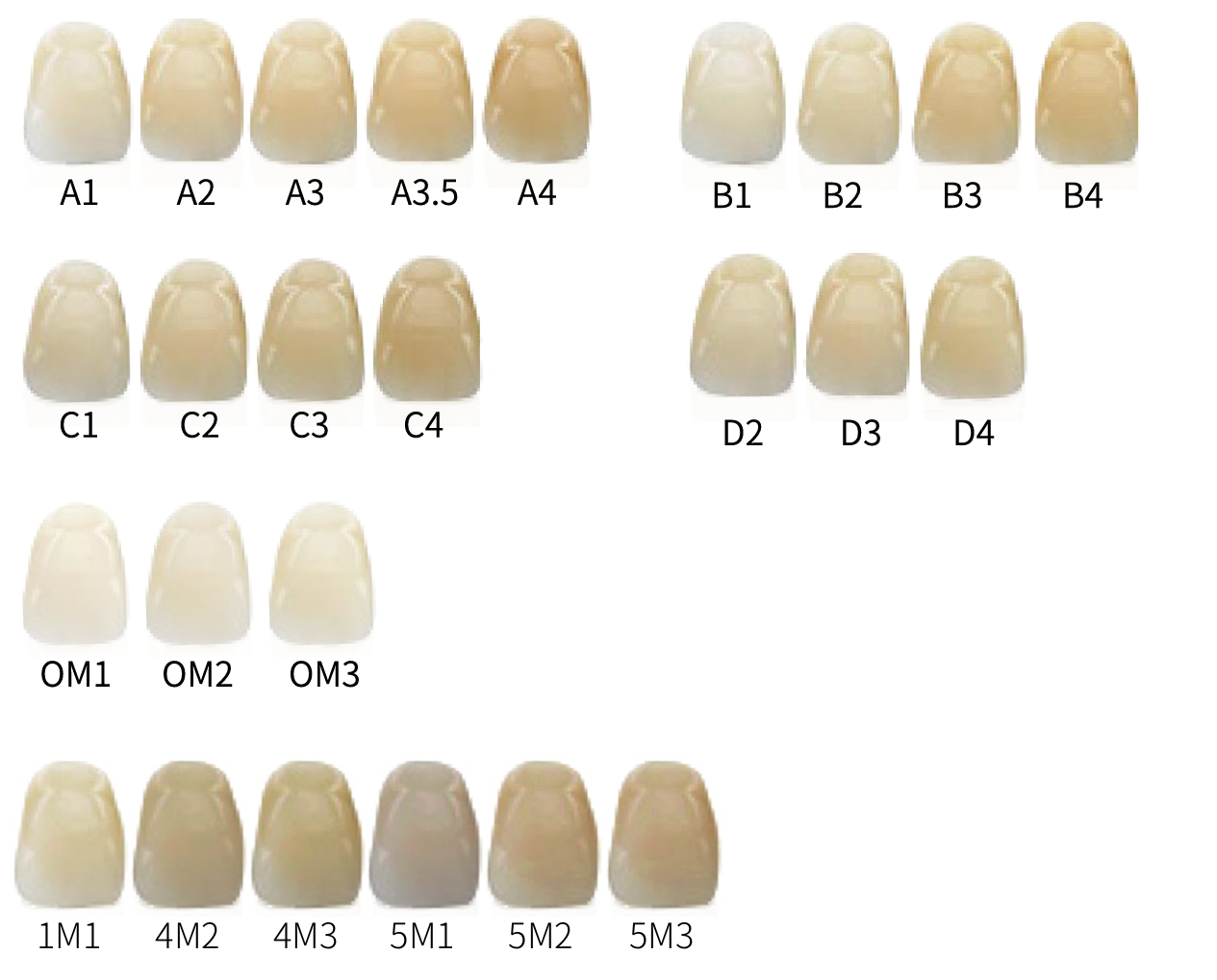
Strength is only half the decision. The reason lithium disilicate has not been pushed out of the anterior is that it handles light beautifully. A glass-ceramic has depth and a chameleon effect that blends into adjacent teeth without much effort. For a single central incisor next to a natural neighbor, a skilled ceramist will usually reach for disilicate, often cut back and layered, because the margin for a visible mismatch is unforgiving up front.
Zirconia has closed a lot of this gap. Early 3Y zirconia looked like a bathroom tile, and that reputation stuck longer than the material deserved. Modern 5Y and multilayer formulations are genuinely translucent. Aidite's 3D Pro Zir publishes a gradient translucency of roughly 57% at the incisal down to 43% at the cervical, the lower cervical value is deliberate, it helps mask a dark prep or metal abutment. That is a real esthetic tool, not a spec-sheet flourish.
The honest line: a high-translucency multilayer zirconia is excellent for full-contour anterior crowns and looks great in most mouths. For the single toughest esthetic case, a layered disilicate restoration still has a ceiling that monolithic zirconia has not quite reached. The flip side is that 5Y zirconia gives up strength to get that translucency, so you are back to weighing the same trade-off from the other direction.
Cementation and prep: a practical difference
This one decides more cases than people expect. Lithium disilicate is etched with hydrofluoric acid, silanated and adhesively bonded. Done right, that bond is part of the restoration's strength, the substrate and the cement work together. Done in a wet field with poor isolation, you lose part of what you paid for. Disilicate effectively requires a bondable situation.
Zirconia is more forgiving. It can be conventionally cemented and does not depend on an enamel-bonded seat to hit its numbers. For a short clinical crown, a subgingival margin, or any prep where isolation is a fight, that tolerance is worth a lot. It also means zirconia is the more predictable choice for an implant crown or a screw-retained restoration where bonding chemistry is not the point.
Reduction differs too. Zirconia can run thinner, roughly 0.5 mm in spots, which helps when you want to stay conservative on a prep. Disilicate generally wants closer to 1.0 to 1.5 mm of occlusal clearance to be safe. If the patient will not give up that much tooth, the material is choosing itself.
Where Amber Press and disilicate are the right answer
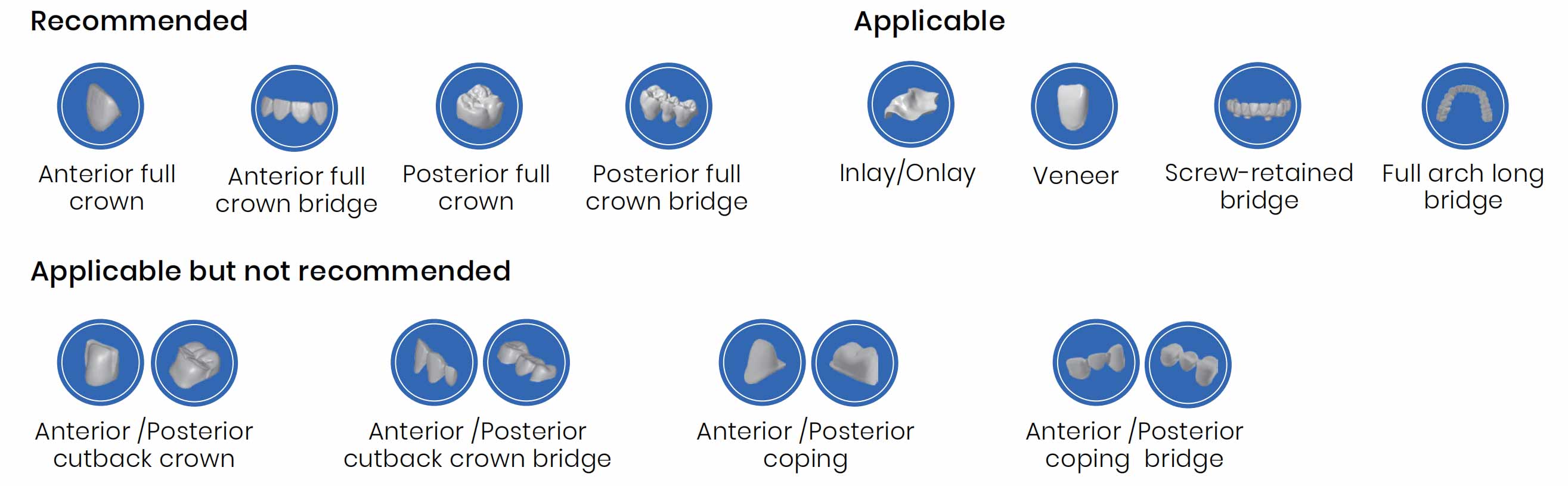
Lithium disilicate is the pick for thin bonded veneers, inlays and onlays, and single anterior crowns where esthetics lead and the occlusion is manageable. It is also the friendlier material for a press workflow, the lab presses to a thin reaction layer and finishes with stain and glaze. Hass Bio's Amber line covers both lanes, Amber Press for the pressed route and Amber Mill blocks for chairside and lab milling, with multiple translucency levels and a wide shade range.
The constraints are the constraints. Short-span only, anterior and premolar three-unit bridges at most, and a bonded seat for full performance. Inside those lines it is hard to beat. Outside them you are asking the material to do a job it was not built for.

Where zirconia is the right answer
Zirconia takes the posterior, the long span, and the cases where you cannot control the field. Molar crowns on heavy occlusion, posterior bridges, full-arch implant frameworks, and conventionally cemented units all sit squarely in zirconia territory. Multilayer 4Y/5Y discs let you carry that strength into the esthetic zone without the old opaque look, which is why a single multilayer disc now covers a lot of a lab's daily output.
The trade-off to keep honest: the most translucent zirconia is also the weakest zirconia. A 5Y disc is not a 3Y disc, so for a bruxer's molar you step down in translucency and back up in strength, or you choose a multilayer that puts the stronger composition where the load is. That is exactly what the gradient discs are doing, and it is why matching the disc to the indication matters more than picking one disc for everything.
A quick decision rule
Most cases sort themselves with a few questions. Is it anterior and esthetics-critical, with good isolation and enough reduction? Lithium disilicate, likely layered. Is it posterior, a bruxer, a long span, a thin prep, or a conventionally cemented or screw-retained unit? Zirconia, with the translucency grade matched to how visible and how loaded it is. Is it a thin veneer, inlay or onlay? Disilicate. Is it a full-arch implant bridge? Zirconia.
The gray zone is the single premolar or first molar in a patient with a normal bite and decent esthetic demands. Either material works. There the call usually comes down to your isolation, the lab's strengths, and whether the patient is sitting in the esthetic zone of their own smile. Neither answer is wrong.
Match the material to the case
Stocking both lanes keeps your options open: Aidite multilayer zirconia discs and blocks for strength and full-contour work, Hass Bio Amber Press and Amber Mill for bonded esthetics. Compare grades, strengths and shades before you order.
Shop Aidite zirconiaShop Hass Bio Amber