
vhf R5 Milling Machine Guide
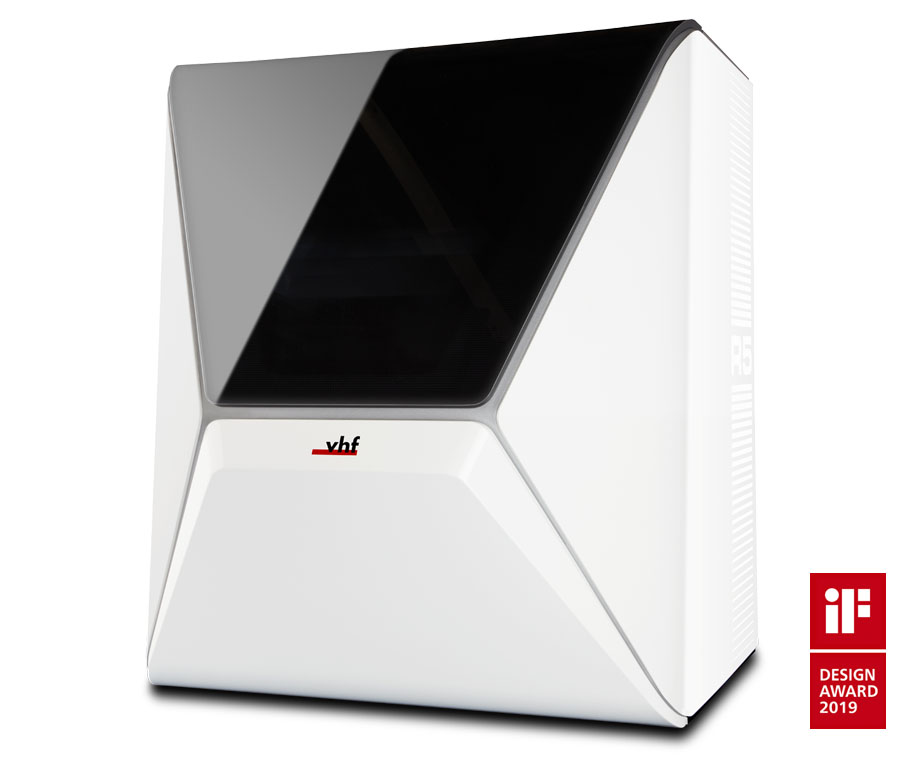
The vhf R5 is a production-grade 5-axis mill built for unattended runs. It carries a 10-blank changer and a robotic arm, processes both wet and dry, and is meant to mill through a queue of discs overnight without an operator. This is the machine for a lab that wants volume.
Two things separate the R5 from the smaller vhf mills: the fifth axis and the wet-and-dry flexibility. Both decide what work it can take on, so they come first.
Specifications at a glance
| Specification | VHF |
|---|---|
| Class | Production 5-axis wet/dry mill |
| Axes | 5 axes (X, Y, Z + A 360° + B ±35°) |
| Processing | Wet and dry, switchable (directclean) |
| Spindle | Up to 80,000 RPM; 800 W peak / 600 W nominal |
| Repeatability | ±0.003 mm (3 µm) |
| Blank changer | Up to 10 blanks / block / abutment holders |
| Tool changer | Removable, 16 tools |
| B-axis | ±35° rotation |
| Materials | Zirconia, CoCr, titanium, glass ceramics, composites, PMMA, wax, model plaster |
| Compressed air | 6–8 bar at 120 L/min |
| CAM software | hyperDENT or dentalcam |
Why the fifth axis changes what a lab can mill
The R5 adds a fifth axis: a B-axis that tilts the blank up to ±35°. With the spindle able to approach the work from an angle, the machine reaches geometry a 4-axis mill cannot, such as undercuts, angled and angulated screw channels, and the full inside of multi-unit bridges. For implant-supported and large bridge work, that angled access is the whole point.
Five axes also tend to produce cleaner surfaces in deep or curved areas, because the tool can stay better aligned to the surface instead of reaching in at a fixed angle. That is the practical reason production labs want five axes rather than four.
Wet and dry on one machine
The R5's directclean technology lets it switch between wet and dry on the fly, with an integrated coolant tank and air nozzles. That flexibility is what makes it a single mill for a mixed material list. Zirconia, CoCr and PMMA are normally milled dry, while glass ceramics and titanium are milled wet, and a wet-and-dry machine covers both without a second mill on the bench.
Running both modes does require compressed air at 6–8 bar (120 L/min), which is a real install consideration: the lab needs a suitable air supply, unlike a purely dry machine such as the E5.
Built for unattended production
The R5's blank changer holds up to 10 discs, block holders or abutment holders, and a robotic arm swaps them automatically. With a 16-tool removable magazine and breakage detection, the machine can work through a full queue of jobs overnight or over a weekend without anyone reloading it. For a lab measuring output in discs per day, that unattended capacity is the reason to buy this model over a single-blank mill.
Materials and software
The R5 covers the broad lab material list: zirconia, CoCr, titanium, glass ceramics, composites, PMMA, wax and model plaster. It pairs with hyperDENT or vhf's dentalcam, so a lab can keep its existing CAM strategy and nesting workflow.
Where the R5 fits the vhf lineup
The R5 is the high-capacity 5-axis option: angled access plus wet-and-dry plus a 10-blank changer for hands-off production. Compared with the K5+, which is a powerful dry-only 5-axis mill, the R5's argument is material flexibility and automated throughput. Compared with the smaller N4+ and Z4, it is in a different class of volume entirely.
See the vhf R5 at Dentcore
Dentcore is a U.S. source for vhf milling machines. Review the R5's 5-axis, wet/dry production setup and changer capacity, or ask about lab integration.
View vhf R5Browse all vhf milling machines →