
vhf N4+ Milling Machine Guide
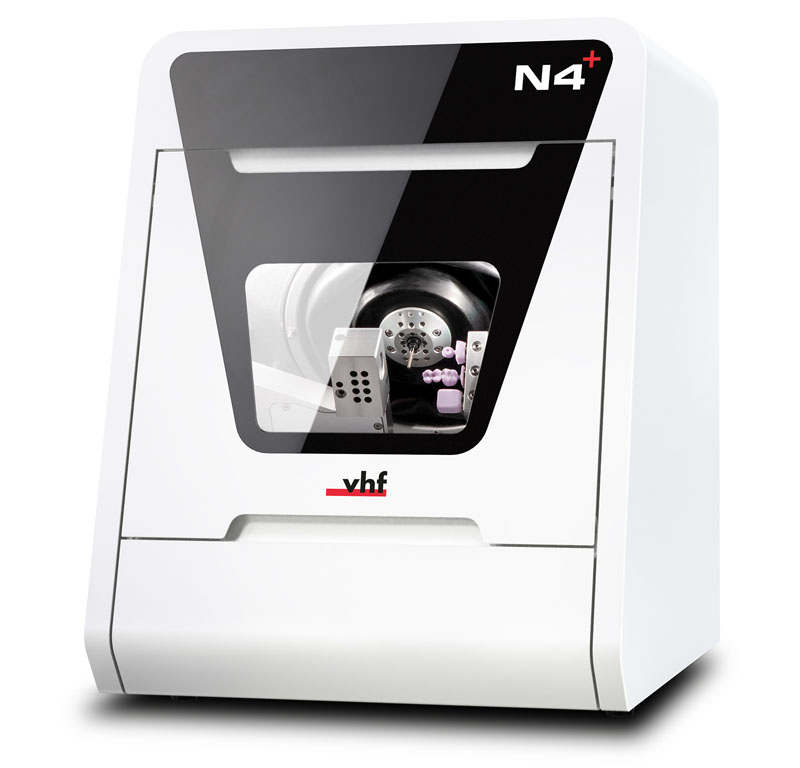
The vhf N4+ is a 4-axis wet lab mill, and its defining claim is precision on titanium. It is validated for milling titanium implant abutments, holds three blocks at once, and runs a high-speed water-cooled spindle. It is vhf's workhorse for wet block milling a step above chairside.
The N4+ keeps four axes but is a heavier, lab-grade machine than the Z4. The axis count and the wet processing are still the first things to understand.
Specifications at a glance
| Specification | VHF |
|---|---|
| Class | Lab 4-axis wet mill |
| Axes | 4 axes (simultaneous control) |
| Processing | Wet machining, water-cooled spindle |
| Spindle | Up to 80,000 RPM; 800 W peak / 600 W nominal |
| Titanium accuracy | −10 to +26 µm (University of Washington study) |
| Repeatability | ±0.003 mm (3 µm) |
| Materials | Glass ceramics, titanium, zirconia, composites, PMMA |
| Block capacity | 3 blocks, up to 45 × 20 × 20 mm each |
| Tool changer | Removable, 8 tools |
| Spindle bearing | 4-fold hybrid ceramic ball bearing, <3 µm concentricity |
| Coolant | Integrated 3.5 L cooling tank, multiple nozzles |
| CAM software | dentalcam included |
What 4 axes do and do not cover here
Like the Z4, the N4+ uses four axes: X, Y, Z plus one rotation of the blank. That handles crowns, copings, inlays, onlays and, importantly, titanium abutments milled from blocks. The limit is the same as any 4-axis machine. It cannot tilt the spindle to reach steep undercuts or sharply angled screw channels, which is 5-axis work.
The N4+ is positioned so that limit rarely bites: it is built for the high-precision single-component work, especially implant abutments, that four axes do well, not for large angled bridge frameworks.
Why wet processing matters for titanium and glass ceramics
The N4+ is a wet mill with a water-cooled spindle, multiple coolant nozzles and a 3.5 L tank. Wet processing is what lets it cut titanium and glass ceramics. Titanium and glass ceramics both build heat at the cutting edge, and flooding the cut clears that heat and the swarf. Cleaner, cooler cutting is also why the titanium results are tight.
That precision is the N4+'s headline. An independent University of Washington study measured titanium-abutment accuracy of −10 to +26 µm, which is the implant-component range where fit actually matters. For a lab milling its own abutments, that is the number to weigh.
Spindle, speed and bearing
The spindle runs up to 80,000 RPM at 800 W peak, on a 4-fold hybrid ceramic ball bearing with under 3 µm concentricity deviation. Higher spindle speed gives clean cuts in titanium and CoCr, where slow cutting builds heat and wears tools. The ceramic bearing runs smoother and lasts longer than steel, which shows up as better surface finish and longer spindle life over production runs.
An 8-tool removable magazine covers the roughing-to-finishing bur set for a material without operator swaps mid-job.
Three-block capacity
The N4+ holds three blocks at once, each up to 45 × 20 × 20 mm. That is a real throughput difference from a single-block chairside mill: a lab can queue several units and let the machine work through them, rather than reloading after every cut.
Where the N4+ fits the vhf lineup
The N4+ sits between the chairside Z4 and the 5-axis machines. It is the choice when a lab wants wet block milling with validated titanium accuracy and modest batch capacity, but does not need disc-based production or the angled access of five axes. When the work moves to angled screw channels, large bridges, or unattended disc production, the 5-axis R5, K5+ or E5 are the right step up.
See the vhf N4+ at Dentcore
Dentcore is a U.S. source for vhf milling machines. Review the N4+'s titanium validation, materials and capacity, or ask about lab workflow fit.
View vhf N4+Browse all vhf milling machines →