
Asiga Ultra 50 Dental 3D Printer Guide
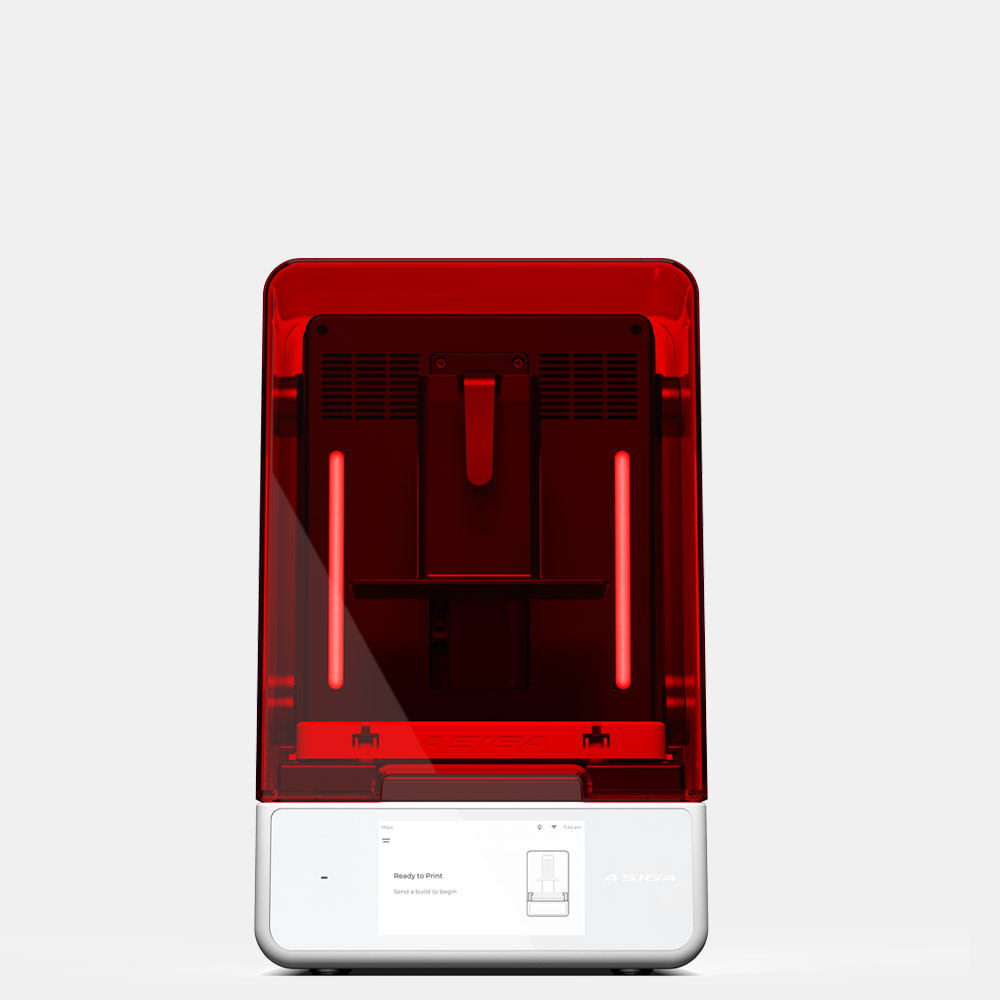
The Asiga Ultra is the accuracy flagship of Asiga's desktop range, built for labs and practices that want the finest detail Asiga offers without moving to a floor-standing machine. The 50 configuration pairs a 50 µm pixel with a larger build area than the 32 version. What separates the Ultra from most desktop printers is not a single spec but two engineering systems, SPS and dual heating, that target dimensional accuracy directly. Here is how they work.
Specifications at a glance
| Specification | Asiga |
|---|---|
| Imaging | 4K DLP, 1920 × 1080 chip with pixel-shift to a simulated 3840 × 2160 |
| XY pixel | 32 µm or 50 µm |
| Build volume (Ultra 50) | 189 × 106 × 130 mm |
| Light source | 385 nm (365 nm / 405 nm on request) |
| Accuracy system | Smart Positioning System (SPS), four corner position encoders |
| Heating | Air heater up to 50°C, four IR heaters up to 70°C |
| Clear materials | Transparent Mode |
| Material system | 100% open, 500+ qualified resins |
| Connectivity | Wi-Fi, Wireless Direct, Ethernet |
| Weight | 32.5 kg (71.5 lb) |
| Software | Asiga Composer, lifetime updates, unlimited installs |
SPS: the Ultra measures its own layers
Most desktop printers drive the build plate to a commanded position and trust that the layer formed at the right thickness. In practice, a large cross-section or a viscous resin pushes back on the plate and the actual layer can come out slightly off. Over a tall part those small errors accumulate into dimensional drift.
Asiga's Smart Positioning System answers that with four position encoders, one at each corner of the build plate, that monitor mechanical deflection during printing. The printer measures what the plate is actually doing and forms each layer to its true thickness regardless of cross-sectional area or resin viscosity. SPS is the core reason the Ultra holds accuracy on demanding geometry, and it is the main thing you are paying for over a conventional desktop machine.
4K imaging, and what pixel-shift really means
The Ultra's imaging is worth reading carefully. The native chip is 1920 × 1080. Asiga uses a piezoelectric pixel-shift to produce a simulated 3840 × 2160 (4K) image, physically nudging the projection to place pixels between the native positions. The effective resolution is fine enough for thin veneers, tight-tolerance surgical guides, and partial-framework detail. Knowing it is pixel-shifted rather than a native 4K chip is the honest version of the spec, and for dental geometry the resulting detail is what matters.
The 50 configuration uses a 50 µm pixel and a 189 × 106 × 130 mm build area. The 32 configuration drops to a 32 µm pixel for finer detail on a smaller platform. The choice is the familiar one: finer pixel or larger area.
Dual heating for consistent resin
The Ultra controls resin temperature with two systems working together. An air heater brings the chamber up to 50°C (about 15°C above ambient), and four corner-mounted IR heaters reach up to 70°C. Holding the resin at a stable, elevated temperature keeps viscosity consistent, which is what temperature-sensitive materials need to print accurately. Combined with SPS, the heating is the second half of the Ultra's accuracy story: stable material plus measured layers.
Transparent Mode is included as well, improving resolution on clear and water-clear materials such as aligners and surgical guides without affecting cure kinetics.
Fully open materials
The Ultra runs a 100% open material system. You can print Asiga's own resins or any qualified third-party material, with 500+ profiles available, so you choose the best resin for each application rather than the one a printer vendor sells. The 385 nm light source covers most dental materials, with 365 nm and 405 nm available on request for specific resins. Asiga Composer is included with lifetime updates and unlimited installs.
Where the Ultra fits
The Ultra is the desktop printer to choose when accuracy is the priority: high-aesthetic crowns, thin veneers, fine surgical guides, and partial frameworks where edge detail and dimensional fidelity decide the result. If your work is mostly models and bases at volume, the MAX 2 or the larger Pro 4K platform is more printer per dollar. The Ultra earns its premium specifically on the cases where SPS-level accuracy is the point.
See the Asiga Ultra at Dentcore
Dentcore is a U.S. Asiga distributor. Review the Ultra desktop printer, its SPS accuracy system, and the open material workflow.
View Asiga UltraCompare Asiga MAX 2Browse all Asiga printers and post-processing →