
Shining 3D MetiSmile MR Face Scanner Guide
Most dental scanners capture teeth. The MetiSmile captures the face, and the MR version adds something neither a model scanner nor an intraoral scanner can do: it records how the jaw actually moves. That makes it a different tool with a different job, and it only earns its place in a practice that designs around the whole face and its function, not just the prep.
This is a facial scanner with a mandibular-movement module. It is used for digital smile design, treatment communication, and capturing jaw motion for functional planning. Here is what it captures, why the MR motion data matters, and the case types it actually serves.
Specifications at a glance
| Specification | Shining 3D |
|---|---|
| Scanner type | 3D facial scanner with MR (mandibular movement) module |
| Scan time | 10 seconds (multiple angles) |
| Accuracy | 50 µm |
| Data cameras | 3 × 1.3 MP |
| HD texture camera | 5.0 MP |
| Working distance | 500 mm |
| Field of view | 210 × 270 mm |
| Weight | 800 g (1.76 lb) |
| MR module | Mandibular trajectory tracking |
| Motion captured | Opening/closing, protrusion, L/R excursions, chewing |
| Tracking methods | Direct tooth markers or bite fork attachment |
| GPU required | NVIDIA RTX 2060 6 GB or higher |
A face scanner, not a tooth scanner
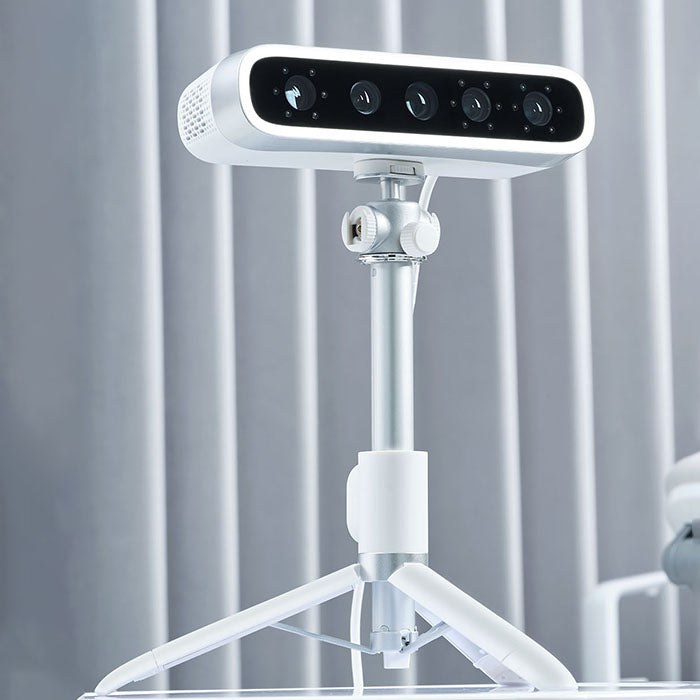
The MetiSmile sits outside the categories most buyers know. It does not digitize a die or a prep. It captures the patient's face in 3D, with texture, in about 10 seconds across multiple angles. The accuracy figure, 50 µm, looks coarse next to a lab scanner's 8 µm, and that is expected: facial scanning answers a different question. You are recording the shape and proportion of the face, not a margin line.
That data feeds digital smile design. By aligning an intraoral scan to a facial scan, a clinician or technician can design restorations in the context of the lips, midline, and smile arc rather than in isolation. It is also a strong communication tool, since a patient can see a proposed result mapped onto their own face.
What the MR module adds
The MR in the name is the reason to choose this version over the standard MetiSmile. The MR module tracks the trajectory of the mandible, the actual path the lower jaw travels, rather than recording a single static bite. It captures opening and closing, protrusion, left and right excursions, and chewing patterns.
The distinction matters because a static bite registration is one frozen moment. Function happens in motion. Recording the movement gives objective data for occlusal and functional analysis that a single bite cannot provide.
Replacing the mechanical facebow
Traditionally, capturing jaw movement meant a mechanical facebow and pantograph, physical instruments clipped to the patient and transferred to an articulator. The MR module is meant to do that digitally in one capture. The motion data can be exported to CAD software so restorations are designed against how the jaw actually moves, a step toward genuine virtual articulation.
There are two ways to capture the movement: direct tooth markers, or a bite fork attachment. Which is appropriate depends on the case and the workflow, and is worth confirming for the indications you plan to run.
TMJ assessment and functional planning
Because it records real motion, the MR version supports TMJ assessment. A clinician can visualize restricted opening, deviations, and asymmetric movement patterns as objective, repeatable data rather than a subjective note. That same record can be used to monitor a patient over time.
This is where the tool fits a specific practice profile: one doing functional restorative work, full-mouth rehabilitation, or TMD evaluation, where understanding the path of the jaw changes the treatment plan. For a practice doing mostly single-unit restorative work, that capability is real but may go unused.
The practical requirements
The hardware is light, 800 g, and works at a 500 mm distance with a 210 × 270 mm field of view, which comfortably covers the face. The one requirement worth flagging before purchase is the computer: the software calls for an NVIDIA RTX 2060 6 GB or better GPU. Facial and motion data are heavy to process, so the workstation matters as much as the scanner.
Confirm your machine meets that bar, or budget for one that does, so the scanner performs as intended out of the box.
Standard MetiSmile versus MR
The choice is straightforward. The standard MetiSmile does facial scanning for smile design. The MR version does everything the standard does and adds mandibular-movement tracking. If you want jaw-motion data for functional planning, articulation, or TMJ work, the MR is the version that delivers it. If you only need static facial capture for esthetic design, the standard model covers that at a lower cost.
See the MetiSmile MR at Dentcore
Dentcore carries the MetiSmile MR facial scanner with the mandibular-movement module. Review the specs, confirm GPU and workflow requirements, and check current availability.
View MetiSmile MR Face ScannerBrowse all Shining 3D scanners and printers →